
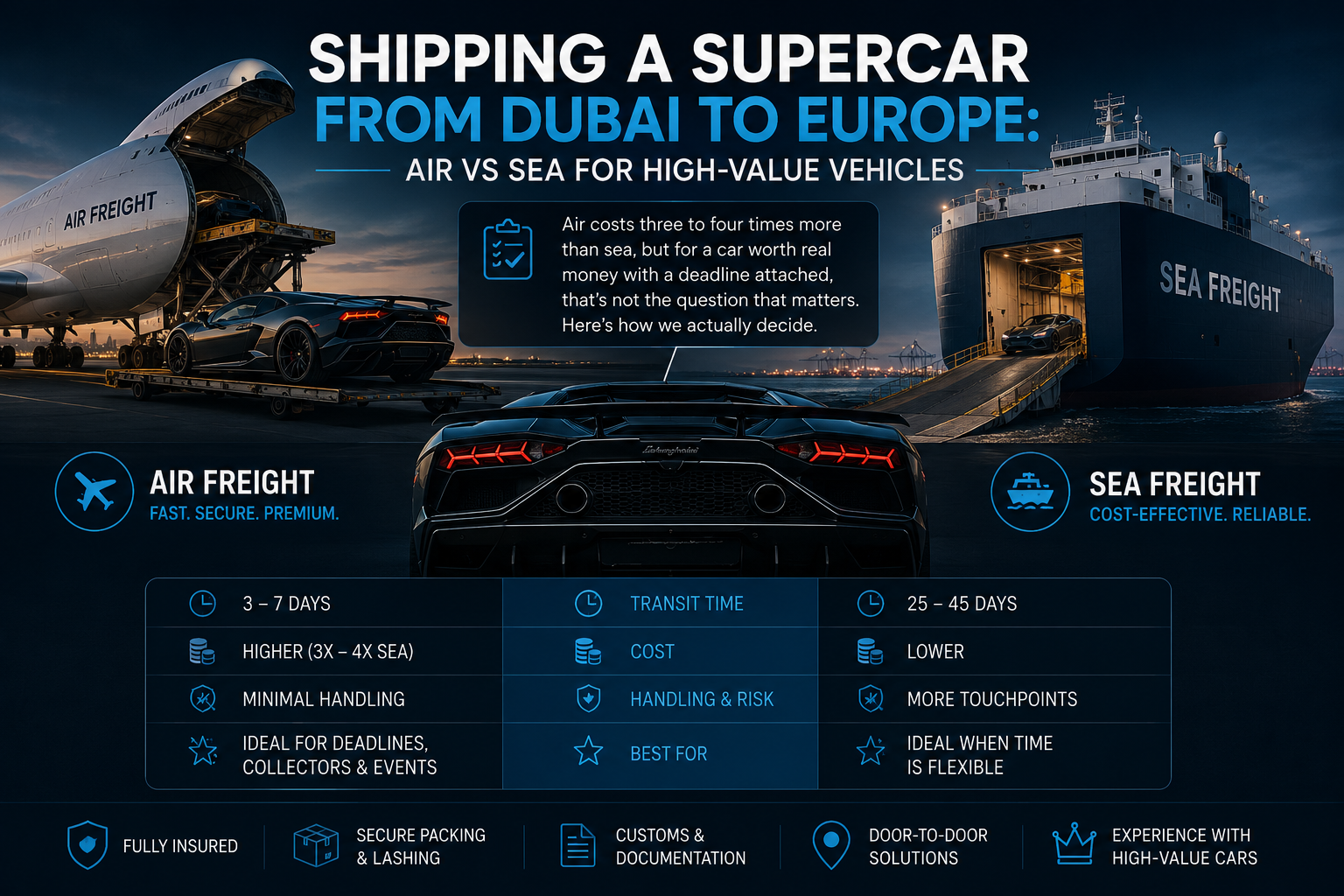
If your car is worth a few hundred thousand dirhams, the air-versus-sea question barely matters. Both are safe. Pick based on convenience. Once you're into seven figures, though, the calculation actually changes, and getting it wrong costs more than the freight bill.
The real cost and time gap
Air freight from Dubai to Europe runs three to four times the price of sea freight. That's the number everyone fixates on. It's also the wrong number to fixate on, because air and sea aren't competing on price at all. Sea is the economical option. Air is the insurance policy against time.
Air freight is airport to airport in two to eight days, depending on routing and customs at both ends. Sea is port to port in thirty to forty-five days, when nothing goes wrong. And things going wrong is more common than people assume — a thirty-five day quote can quietly stretch to fifty just from a vessel skipping a port or a schedule shuffle that has nothing to do with your shipment specifically.
If there's a hard date attached to your shipment, that gap is a real risk, not a theoretical one.
Where we actually draw the line
We handle this calculation often enough to have a real answer rather than a shrug. Anything worth more than AED 1,000,000, we'd recommend air. Below that, sea's cost advantage usually wins out. Above it, a five or six week delay starts carrying its own cost — insurance gaps, storage, a buyer who's done waiting — and the math flips.
A few things override the value threshold entirely:
Air, regardless of value: an auction deadline, a concours date, an insurance handover already booked, a buyer with a limit on patience. If the car's coming from an overseas auction, a pre-purchase inspection before it ships is worth arranging too, especially when the timeline is already tight and there's no room to discover a problem after arrival.
Sea, even for an expensive car: no fixed date, the owner's just relocating it, and the route has a carrier track record you trust.
How the cars actually fly
We work with Emirates SkyCargo, Etihad Cargo, Turkish Cargo, Qatar Airways Cargo, Silk Way West, Cargolux, Uzbekistan Airways, Challenge Airlines, My Freighter, and charter when none of those fit the timeline.
Lower-deck matters here. Emirates, Etihad, and Uzbekistan Airways can take a low-profile car in the belly hold of a passenger or combi aircraft, which usually books faster since you're not waiting on a dedicated freighter. A taller car needs main-deck, a 777F or similar, which means working around freighter schedules specifically. And when the only freighter slot is two weeks out and the deadline can't move, that's when charter earns its premium.
Sea freight isn't the fallback option
It's worth saying plainly: most cars, including plenty of valuable ones, ship by sea and arrive exactly as they left. We brace the wheels in an L-shape with wood and tie down at all four axles, the same method whether the car is worth fifty thousand dirhams or five hundred thousand. Sea is the right call whenever there's no deadline forcing the decision. Air is the right call when the deadline is the entire decision.
If you're shipping something rarer or older rather than newer and faster, the calculation shifts again — worth a look at our guide on classic car shipping from Dubai if that's closer to your situation.
If you're not sure which side of the line your car falls on, get in touch and we'll run the actual numbers for your route, not a generic answer.